
Dynamica Research Lab
UNIVERSITÉ LAVAL, QUÉBEC, CANADA
Understanding the structure and the dynamics of complex systems.
About us
We are a multidisciplinary research group dedicated to understanding the structure and dynamics of complex systems. Our approach integrates theoretical methods from fields such as statistical physics, nonlinear dynamics, differential geometry, statistical inference, and machine learning. We collaborate closely with other research groups, particularly experimental labs that generate data from real-world complex systems. Our research finds application in neuroscience, epidemiology and ecology.
Current research topics include:
- Embedding complex networks in hyperbolic space
- Determining how the brain’s shape influences patterns of neuronal activity
- Analyzing symmetries and dynamical properties of complex systems using Koopman operator theory
- Studying the stability of ecosystems and detecting critical species from co-occurrence patterns in ecological data
- Investigating the fundamental limits of network reconstruction from observational data using information-theoretic approaches
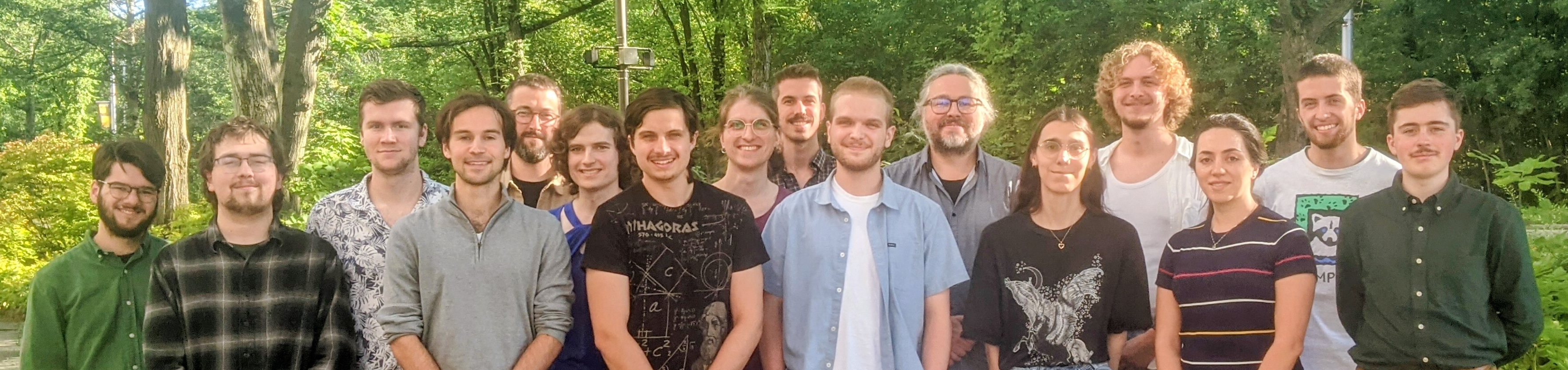
Dynamica Lab annual scientific symposium (Aug. 2026)
(left to right) Louis G., Félix D., Jérémie H., Arthur L., Antoine A., Ariane L., Bastien B., Jordan C., Antoine L., Benjamin C., Patrick D., Mai O., Olivier R., Zahra Y., Thomas P., Clément T.
News and recent activities
2026-06-05 — Habemus novum Doctor! Vincent Thibeault has successfully defended his Ph.D. thesis (see the abstract here). His dissertation, entitled “Approches spectrales et conditions structurelles pour réduire la dimension des systèmes complexes”, introduces spectral approaches for reducing the dimension of complex systems and establishes general structural conditions for exact dimension reduction. It also proposes the low-rank hypothesis for complex systems and demonstrates how it provides a natural explanation for the emergence of higher-order interactions.
The examination committee was composed of Antoine Allard (director, Université Laval), Patrick Desrosiers (co-director, Université Laval), Jean-François Fortin (examiner, Université Laval), Nicolas Doyon (examiner, Université Laval), Renaud Lambiotte (external examiner, University of Oxford), and was chaired by Tigran Galstian (Université Laval). Recognized for its exceptional quality, Vincent’s dissertation will be added to the Tableau d’honneur (Board of Honour) of the Faculty of Graduate and Postdoctoral Studies at Université Laval.
Vincent’s remarkable doctoral work has also been recognized through prestigious postdoctoral fellowships, including the Canada Postdoctoral Research Award Program and the Wu Tsai Postdoctoral Fellowship at Yale University. He will begin his postdoctoral research at Yale in September 2026.
We warmly congratulate Vincent on this outstanding achievement and wish him every success in this exciting new chapter of his academic career!
2026-05-25 — New manuscript on arXiv: The impact of behavioral homophily and conformity on epidemic spreading in networks with large groups.
2026-05-07 — [Alumni update] Laurent Hébert-Dufresne was awarded the 2026 Erdős–Rényi Prize by the Network Science Society for foundational contributions to the theory of contagion on complex networks, illuminating how network structure, higher-order interactions, and nonlinear transmission mechanisms shape the spread of diseases, behaviors, and ideas.
The Erdős–Rényi Prize is awarded each year to a selected young scientist (under 40 years old on the day of the nomination deadline) for their research achievements in the area of network science, broadly construed. While the achievements can be both theoretical and experimental, the prize is aimed at emphasizing outstanding contributions relevant to the interdisciplinary progress of network science. (from the NSS website)
2026-02-02 — We are delighted to share that Benjamin Claveau has been awarded the distinction of the Tableau d’honneur of the Faculty of Graduate and Postdoctoral Studies at Université Laval. His M.Sc. thesis in Physics, “Perspective spectrale sur la dynamique des systèmes complexes par la théorie de Koopman”, received unanimous excellent evaluations from the jury, earning him this prestigious recognition.
We are especially pleased that Benjamin has decided to continue his PhD in Physics within the Dynamica Research Lab, where he will further develop research on the Koopman operator theory of complex systems.
Congratulations to Benjamin for this remarkable achievement and for continuing the Dynamica tradition of excellence.
2025-09-04 — Charles Murphy has successfully defended his Ph.D. thesis on June 9th (see the abstract here). His dissertation, entitled “Reconstruction dans les systèmes complexes”, explores how the structure and dynamics of complex systems can be jointly inferred from data, unifying the problems of network reconstruction and dynamical prediction within an information-theoretic framework.
The examination committee was composed of Antoine Allard (director, Université Laval), Jean-François Fortin (examiner, Université Laval), Nicolas Doyon (examiner, Université Laval), Giovanni Petri (external examiner, Network Science Institute, Northeastern University London), and was chaired by Daniel Côté (Université Laval). The final version of the thesis is available here.
Charles has now successfully completed all Ph.D. requirements and officially received his doctoral diploma on September 1st. He accomplished this impressive journey while building a family and working part-time at Hectiq.AI, where he is now pursuing his career as a Data Scientist. Congratulations, Charles!
2025-09-03 — We are excited to announce that Arthur Légaré and Mai Olivier have just begun their Master’s studies in Physics in our lab. Both previously completed promising research internships with us last year and have chosen to continue their graduate journey at Dynamica. Welcome aboard, Arthur and Mai!
2025-08-12 — New manuscript on bioRxiv: Function aligns with geometry in locally connected neuronal networks.
2025-07-14 — The latest article from our long-standing collaboration with the Paul De Koninck Lab has just been published in Science Advances. This work, driven by the exceptional research of PhD candidate Antoine Légaré and supported by Sentinelle Nord, marks a key milestone in our joint efforts to bridge brain structure and function.
The paper, titled “Structural and genetic determinants of zebrafish functional brain networks,” shows how brain-wide functional imaging and network analysis in zebrafish larvae uncover parallels with human brain networks. By combining whole-brain calcium imaging, structural connectivity from single-neuron reconstructions, and regional gene expression data, the study reveals that functional connectivity reflects underlying anatomical wiring, exhibits hierarchical modularity, and aligns with genetic markers—reproducing features commonly observed in mammalian brains.
A popular science article (in French) by Jean Hamann provides broader context and includes a video showcasing whole-brain neural activity in a larval zebrafish.
For more information, visit our publication page.
2025-05-19 — We are pleased to welcome Louis Grégoire and Bastien Bédard as research interns at the Dynamica Research Lab this summer. Louis, an undergraduate student in physics, will investigate the dynamics of next-generation Hopfield networks. Bastien, who is studying mathematics, will focus on dimensionality reduction in neural networks, in collaboration with Nicolas Doyon from the Department of Mathematics and the CERVO Brain Research Center. We look forward to a stimulating summer of research.
2025-04-30 — We are proud to celebrate the achievements of several members of the Dynamica Research Lab who have been awarded prestigious scholarships from NSERC and FRQNT. These include Benjamin Claveau and Jordan Charest (PhD), Mai Olivier (Master’s), and Louis Grégoire and Bastien Bédard (Undergraduate). Congratulations to all for this well-deserved recognition!